
- Government of Montenegro
DPM Koprivica's statement on the "Možura" affair: ...
DPM Koprivica's statement on the "Možura" affair: New evidence points to corruption, abuse of office and negligence by former Montenegrin officials

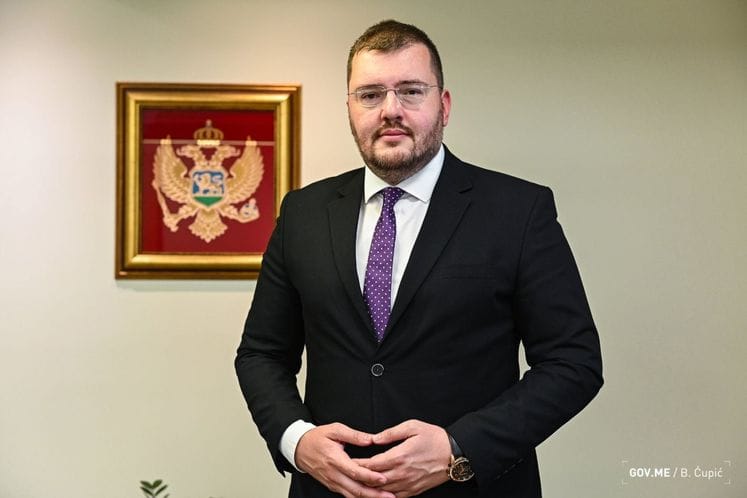
Spanish, as well as Maltese Prosecutor's Office have intensified investigations since September 2024 regarding the corruption scandal "Možura", in connection with which journalist Daphne Caruana Galizia was killed, said Deputy Prime Minister for Political System, Judiciary and Anti-Corruption Momo Koprivica, adding that Europol is assisting Maltese prosecutors, and that the Spanish Prosecutor's Office has launched an investigation against the company Fersa, among other things, for bribing former Montenegrin officials.
Koprivica recalled that in 2010, the Government of Montenegro signed a contract with the Fersa-Čelebić consortium for 20 years on the construction of the Možura wind farm and land lease. During the first 12 years, it was foreseen that the investor would be subsidized with a total of as much as 115.3 million euros.
Fersa reported a project of 100 megawatts (MW) to its shareholders in Spain, while documents available to our institutions show that the planned capacity of the wind farm was only 46 MW. This inflated investment cost is a measure of planned and executed corruption. Although the law and the contract specifically stipulate that the transfer of contractual rights to another company is impossible without the consent of the state, the Fersa-Čelebić consortium did so by transferring it to the Seychelles-based company Cifidex, which did not meet any of the conditions from the Montenegrin tender, which was a requirement in the case of contract transfer, neither in terms of experience in building such facilities nor having an average gross income of 100 million euros in the last three years, explained DPM Koprivica.
He emphasized that although the documentation of Montenegrin institutions mentions and treats only the transfer to Enemalta for 3.5 million euros, for which the then Government led by Milo Đukanović gave its consent, Cifidex appears as the owner of Možura on 9.12.2015, as proven by documents from the register in Montenegro, and this is a trail confirming lawlessness and corruption. In reality, Cifidex bought the contract from the Fersa-Čelebić consortium for 3.5 million euros, and sold it to Enemalta for 10.3 million euros. The inflated price served the purpose of corruptive distribution of the spoils.
By analyzing the documentation, I came across new evidence indicating corruption, abuse of office and negligence by former Montenegrin officials, primarily Milo Đukanović and Branimir Gvozdenović, about which I will inform the competent prosecution. Namely, the Government headed by Đukanović and Gvozdenović deliberately failed twice to terminate the contract with the Fersa-Čelebić consortium and to activate a bank guarantee of 1.5 million euros, thus enabling further contract transfers in the second half of 2015, the distribution of bribes, and unfortunately, as a result of the subsequent investigation, journalist Daphne Caruana Galizia lost her life. According to Article 6.2 of the Contract, the consortium was obliged to submit all necessary documentation for the construction permit within six months after the adoption of the spatial planning documentation. This was not done, the deadline was grossly violated, and Article 13.2 of the Contract provides for termination in case of failure to comply with this deadline, as an essential part of the contract, which the Government did not do. Nor was the bank guarantee in the amount of 1.5 million euros activated, although the state had the right to do so under Article 9.1 of the Contract, emphasized DPM Koprivica.
As he stated in today's statement, an even more blatant circumstance followed. Namely, Article 6.2 of the Contract stipulates that works and construction must begin within 2 months of the issuance of the construction permit, which was issued on 15 December 2014. The final deadline for the start of works was 15 February 2015. However, this deadline was also grossly violated. In a letter dated 4 March 2015, the Department for Construction Inspection of the Directorate for Inspection Affairs informed the competent ministry that no works had begun, that even the notice of the commencement of preparatory works had not been submitted, and that the Fersa-Čelebić consortium itself, as the investor, stated on the record that no construction works had started or been carried out at the Možura site. This information has so far been far from public view.
For any reasonable government, this would be a signal not only of the investor’s incompetence but also of suspicious and harmful intentions. The Government was under a firm obligation to terminate the contract and activate the bank guarantee in the amount of 1.5 million euros, which it had full right to do in accordance with Article 13.2 and Article 9.1 of the Contract. However, this did not happen. Why was the contract not terminated and the bank guarantee activated? Why didn’t the then government exercise its contractual right and thus protect the state’s interest? The answer is clear: it was necessary to preserve the contract and enable its transfer to the phantom company Cifidex, contrary to the contract, and then to Enemalta, all with the aim of inflating the price that would ultimately be paid by the Maltese state-owned company Enemalta, in order to distribute the corrupt rent and satisfy the involved Montenegrin and Maltese officials. One of them, the then Minister of Health and Energy in the Government of Malta, Konrad Mizzi, who is under investigation, sent a letter to the then Montenegrin authorities, about which I have evidence that I believe will be relevant to both our and their prosecution, said Koprivica.
He stated that, although Milo Đukanović claimed the "Možura" affair was entirely legal and that the corruption allegations were merely a campaign of destruction systematically spun by the media, new evidence clearly confirms that his Government knowingly failed to fulfill its obligation – which was to terminate the contract due to missed deadlines and to activate the bank guarantee worth 1.5 million euros. By failing to do so, the Government enabled the continuation of corruption in this project, he added and noted that this case represents a peak of high-level corruption.
I will compile and submit information about all the above to the prosecution, and I hereby call on the competent authorities of Spain and Malta for cooperation that must be comprehensive, and the call will be officially and formally sent, and I welcome their intensified work. Montenegro is obliged to do everything in its power to fully resolve this affair, ensure full criminal consequences for its actors, and clarify the circumstances that led to the murder of the brave journalist Daphne Caruana Galizia, concluded DPM Koprivica.
